
Return to my multitudes
How bread can activate our experience of placemaking with Laura Lazzaroni

Thank you for being here! This is the eighth edition of the Atlas newsletter. Here you can find “The Design of Return podcast - eighth episode” about how food, and in particular bread, can activate our experience of placemaking, an interview with Laura Lazzaroni, author, food expert and bread consultant in between Italy and the United States; show notes and additional resources on the theme for #thelibraryoftransit.
Roots
If I close my eyes and think about my time living in New York, or Paris, or Orange County in California, I can smell the cheese fries, the burger sauce, and the scent of vanilla near the counter of the Shake Shack on 76th and Columbus.
I can taste the viennoise au chocolat, that I used to grab Chez Paul before hopping on the metro to the office at Opera.
I can feel the scorching hot Starbucks macha latte placed in the cup holder in my car, while trying to eat an egg sandwhich mashed into two slices of wholewheat English muffins.
But when I think of Buonalbergo, my small village in the Italian south where I was born, the first thing my senses travel to is bread.
Warm bread, just out of the oven, the crust crunchy and burnt, the sound my grandfather’s knife made while slicing it for dinner, the rusty paper bag to collect the crumbs.
While I was growing up, after leaving the Italian South and entering a new food culture in the North, I encountered new ways of practicing being a family around a table.
Some of our neighbors only had light lunches, sometimes sandwiches, sometimes they skipped lunch all together.
Some gathered around the table at different times. The wife and the daughter first and the husband later, when he would come back from work.
In my family, gathering around the table was the first rule declared out loud when we arrived: no matter what happens, we will always break bread together.
Preserving the sound of the knife on the crispy crust, the sight of crumbles on the floor.
Transporting my grandparents, the South with us, like a portable home.
It seems like my memories of food are always directly connected to my emotional experience of place.
Connecting with my expat life is about connecting to memories of food in transit. In a car, a metro, grabbing fast food or breakfast. When it’s about my roots instead, memories become primordial, familiar, and grounding.
So what does food, and in particular, bread, activate for us in our experience of placemaking?
The Design of Return Episode # 8 “Return to my multitudes” - Show Notes
In today’s episode I interview Laura Lazzaroni, author, food expert and bread consultant.
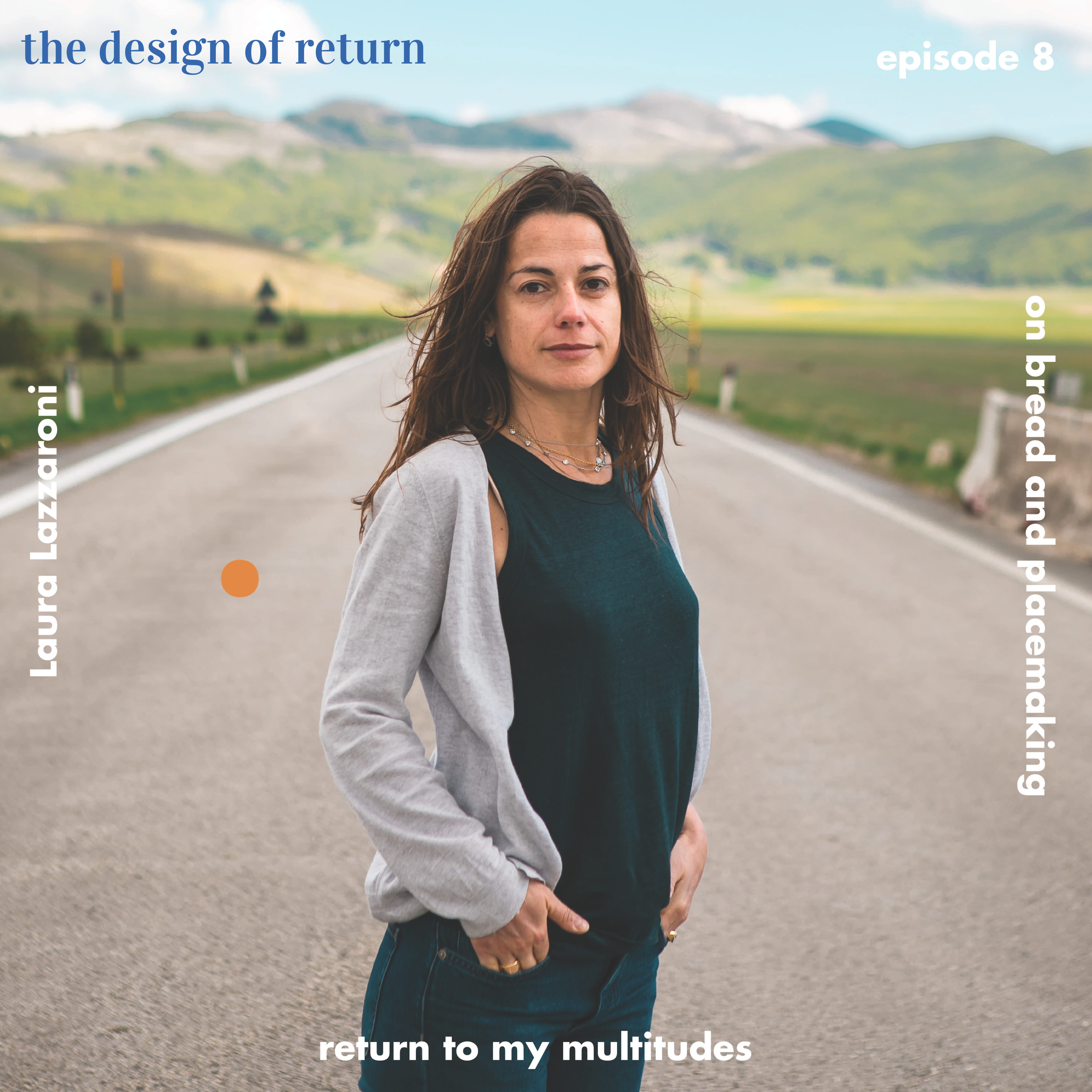
Photo by Alberto Blasetti
Laura is Italian, lived in New York and returned to Italy after five years there. She had lived many lives but is when she discovered her love for wheat that she became part of a new community, not because she had learnt it at home but because she is creatively mastering all of her multitudes to, in her words “massively, enthusiastically, transition into the entrapreneurship of bread all over the world”.
She is the author of several books, like “the New Cucina Italiana” edited by Rizzoli in English, and “La formula del pane” edited by Giunti, in Italian. She recently curated together with professor Massimo Montanari the exhibition “Gusto. Gli Italiani a Tavola. Italians around the table” at M9 Museum in Venice, which they describe as “a big home, made of many rooms that tell the story of Italian Gusto through landscape, biodiversity, homemade cuisine, restaurants, markets, design, migration, environmental challenges, space, education and project making capturing the spirit of a nation through its relationship with food and conviviality.
In our interview we explore how food is one of the main ways to read our surroundings to build and re-build a sense of place, how bread is a non-binary product and the lessons we can learn from wheat about the migrant experience of displacement.
You will notice my voice has a different sound in this episode. Bear with me, as it is the result of more than forty days coughing after a bad virus (not covid, believe it or not) combined with sitting next to a restaurant kitchen where I recorded.
Just like bread, this episode took a long time to be made. Every time we tried to meet, something happened to push if back: a sudden meeting, equipment issues, or travels got in our way for a couple of months. And the cough, of course.
But again, just like bread we understood why the right moment found us: if you listen to the end of this episode, Laura makes a wish, to herself and to the Universe. I met her a week after our recording and with sparkly eyes in front of a slice of sourdough bread chicken sandwich she told me it had come true.
She is now in love.
06:06 Home is where there is flavor, meaning and bread
08:33 On the smell of New York and the freedom from duality
14:05 On the difference between a “house” and a “home”
15:53 On keeping the act of preparing food a secret in her Milanese household as a child
22:00 On growing up with two different style of cuisine: the urban and the country side
23:47 How Laura designs her kitchen experience today
28:00 On New York food craze culture and discovering her relationship with Italian gastronomy there
31:42 On the important of biology as her education and combining science with writing
35:06 When she discovered her love for bread and knew it was here to stay
40:14 “Bread, just like the United States, contains multitudes”
44:29 On how the environmental cultural pressure in Italy flattens your multitudes
51:19 The difference of thinking of bread as a method (fluid) versus a recipe (binary)
52: 47 Lessons from curating her exhibition “Gusto. Italians around the table” and the idea that Italian Gusto comes from encounters
58:38 In which way bread helps the migrant experience
1:04:14 What is the next life she would like to try…
#thelibraryoftransit. Read, watch, learn.
Michael Pollan, “Cooked - A natural history of transformation” is a seminal book for our guest experience and explores the previously uncharted territory of his own kitchen. Here, he discovers the enduring power of the four classical elements—fire, water, air, and earth— to transform the stuff of nature into delicious things to eat and drink. In this book he argues that argues taking back control of cooking strengthen our weakened link with the natural world and people, our friends and family, as a consequence.
Laura Lazzaroni “The new Cucina Italiana” (English, by Rizzoli) is a journey through one the most talked about and globally popular cuisine from the emancipated perspective of thirty-two chefs who are rethinking and reinterpreting their nonna’s kitchen. It is a journey that has come further from its roots through the unseen, arguing how by far the country's most interesting cuisine is to be found outside of well-trodden establishments
Laura Lazzaroni second book, “La Formula del Pane” (Italian, by Giunti) is by far the only book who encouraged me to think of bread in a different way: as a method, a series of connections, rather than a recipe, a series of instructions. This enlightened view on what is the most apparently simple but fascinatingly complex food, has the purpose to give freedom to the baker, even the amateur one.
For the significance of exploring creative gathering in and around a kitchen, Olafur Eliasson “Kitchen” is a must go to. In this exploration, food and creative environment intermingle in a thoughtful and artistic rendition of how food, its spaces and recipes has served as creative inspiration for communal discussion every day for his staff, artists, and guest collaborators, including René Redzepi and Alice Waters.
If you read this newsletter and value it, consider going to the paid version.
If you’re reading this in your inbox, you can find a shareable version online here. Or share with a friend here.
You can follow us on Instagram here. You can follow me on instagram here. Feel free to comment below — and you can always reach me at thedesignofreturn@gmail.com.